


Running a successful restaurant is about more than just great food and service—it’s about financial health. Understanding and improving your restaurant profit margin is the key to sustainable growth, allowing you to invest in your team, enhance your guest experience, and build a resilient business.
This comprehensive guide will explain exactly what profit margin is, how to calculate it, what realistic benchmarks look like, and the most effective strategies to improve it.
What Is Restaurant Profit Margin?
Gross Profit Margin
Gross profit margin measures the profitability of your menu items alone.
It tells you how much money you have left from your total revenue after accounting for the cost of the ingredients needed to produce your food and drinks (Cost of Goods Sold or COGS).
- Profit margin formula restaurant (Gross): (Total Revenue - COGS) ÷ Total Revenue x 100
- Example: If you generate £20,000 in revenue in a month and your food and beverage costs (COGS) are £6,000, your gross profit is £14,000. Your gross profit margin is (14,000 ÷ 20,000) x 100 = 70%.
Net Profit Margin
Net profit margin is the 'bottom line'—it shows what percentage of your revenue is actual profit after all expenses have been paid. This includes not just COGS, but also labour, rent, utilities, marketing, and taxes. It is the truest indicator of your restaurant’s overall financial health.
- Profit margin formula restaurant (Net): (Total Revenue - Total Expenses) ÷ Total Revenue x 100
- Example: Using the same £20,000 revenue, if your total expenses (COGS + labour + overhead etc.) are £19,000, your net profit is £1,000. Your net profit margin is (1,000 ÷ 20,000) x 100 = 5%.
Why It Matters
Tracking your profit margins is fundamental. It helps you set profitable menu prices, create an accurate budget, identify areas of overspending, and make informed decisions for long-term growth. Without a clear understanding of your margins, it's impossible to know if you are running a financially sustainable business.
Try TheFork Manager today

Average Restaurant Profit Margins
Typical Profit Margins by Restaurant Type
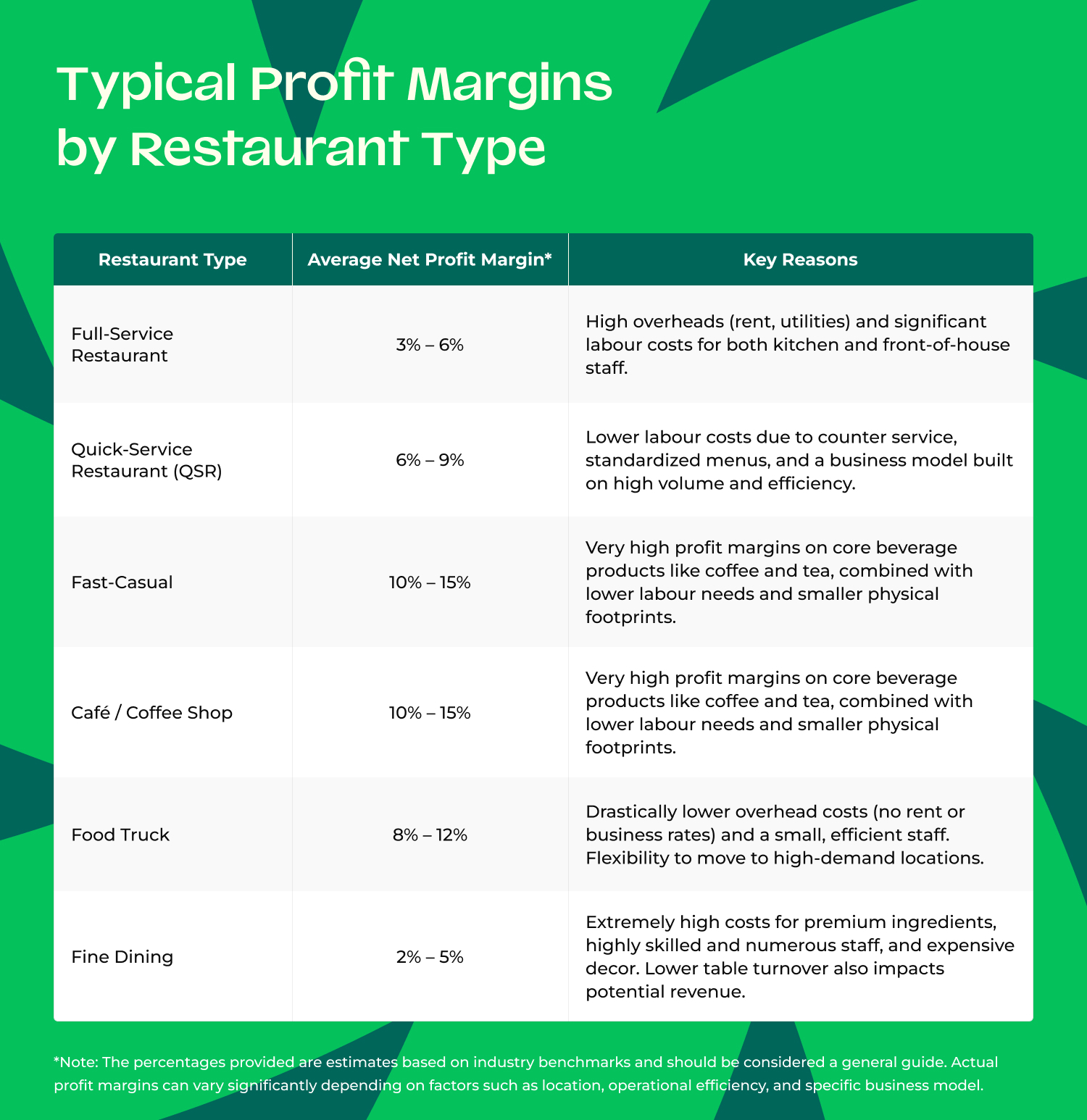
The average restaurant profit margin in the UK typically falls between 3% and 5% (net), though this can vary significantly. According to CLFI report, rising costs continue to put pressure on these margins. The type of restaurant you run has a major impact:
- Full-Service Restaurants: Often have lower net margins (3-6%) due to higher labour costs and overheads.
- Quick-Service Restaurants (QSRs): Tend to have higher margins (6-9%) because of lower labour costs, simplified menus, and higher volume.
- Cafés and Food Trucks: Can achieve higher margins (10-15%+) due to lower overheads, smaller staff, and menu flexibility.
Main Factors Influencing Margin
Several factors determine your potential profit margin:
- Menu Type & Pricing: The complexity of your dishes and your pricing strategy.
- Overhead: High rent in a prime city location will impact margins more than a suburban spot.
- Size & Location: A larger restaurant has higher fixed costs, while location affects everything from rent to wage expectations.
What Impacts Your Restaurant Profit Margin
Cost of Goods Sold (Food & Beverage)
This is the direct cost of the ingredients used to create your menu items. It’s one of the largest and most variable expenses. Poor portion control, waste, or unfavourable supplier pricing can quickly erode your gross profit margin.
Labour and Staff Management
Labour is typically the largest single expense for a restaurant. This includes wages, salaries, taxes, and benefits for all staff, from the kitchen to the front-of-house. Inefficient scheduling or high staff turnover can significantly inflate this cost.
Overhead and Fixed Costs
These are the consistent expenses you have to pay regardless of how many customers you serve. They include rent, business rates, energy and utility bills, insurance, licenses, and marketing software subscriptions. These fixed costs are a major reason why restaurant profit margins are often so slim.
Emerging Challenges
In the current climate, restaurants face additional pressures. Inflation has led to rising food and energy costs, while supply chain disruptions can cause unexpected shortages or price hikes. Managing these external factors is a constant challenge for maintaining a healthy profit margin.
How to Calculate and Track Your Margin
Step-by-Step Calculation
To calculate your profit margin accurately, you need clear financial data for a specific period (e.g., one month).
- Calculate Gross Profit Margin:
- Step 1: Add up your total revenue (sales).
- Step 2: Add up your total COGS (food and drink costs).
- Step 3: Use the formula: (Revenue - COGS) ÷ Revenue x 100.
- Calculate Net Profit Margin:
- Step 1: Start with your total revenue.
- Step 2: Add up all your expenses (COGS, labour, rent, utilities, marketing, etc.).
- Step 3: Use the formula: (Revenue - Total Expenses) ÷ Revenue x 100.
Break-Even Point and How to Find It
Your break-even point is the level of sales at which your total revenue equals your total costs—meaning you are making neither a profit nor a loss. Knowing this number is critical for setting sales targets. To find it, you first need to separate your costs into 'fixed' (rent, salaries) and 'variable' (food, hourly wages).
The formula is: Total Fixed Costs ÷ ((Total Sales - Total Variable Costs) ÷ Total Sales). This tells you the minimum revenue you need to generate to cover all your costs.
Key Ratios to Monitor
Beyond your main profit margin, track these key percentages:
- Food Cost Percentage: (COGS ÷ Revenue) x 100. A healthy target is typically 28-35%.
- Labour Cost Percentage: (Total Labour Costs ÷ Revenue) x 100. This should ideally be under 30%.
- Operating Expenses: These are your overheads. As a percentage of revenue, they highlight how much of your income is consumed by non-food, non-labour costs.
The Fork Manager Restaurant Profit Margin Calculator
To make this process simpler, The Fork Manager offers a free online tool designed to help restaurateurs estimate and improve their profit margins easily.
How It Works
The calculator provides a straightforward way to get a snapshot of your financial health. Users simply enter their average monthly revenue, along with their main operating costs. The tool then instantly calculates your estimated margins, showing you where your business stands.
Benefits of Using the Calculator
Using the calculator provides quick insights without the need for complex spreadsheets. It helps you set realistic financial targets, benchmark your performance against industry averages, and make simpler, more informed decisions about your pricing and cost-saving strategies.
Integration with The Fork Manager
Beyond the calculator, the full TheFork Manager software provides the tools you need to directly action on these insights. By helping you increase bookings through our marketplace, reduce costly no-shows with credit card guarantees, and optimise your operations with smart table management, the platform is designed to directly boost your revenue and improve your restaurant profit margin.
Strategies to Increase Restaurant Profit Margin
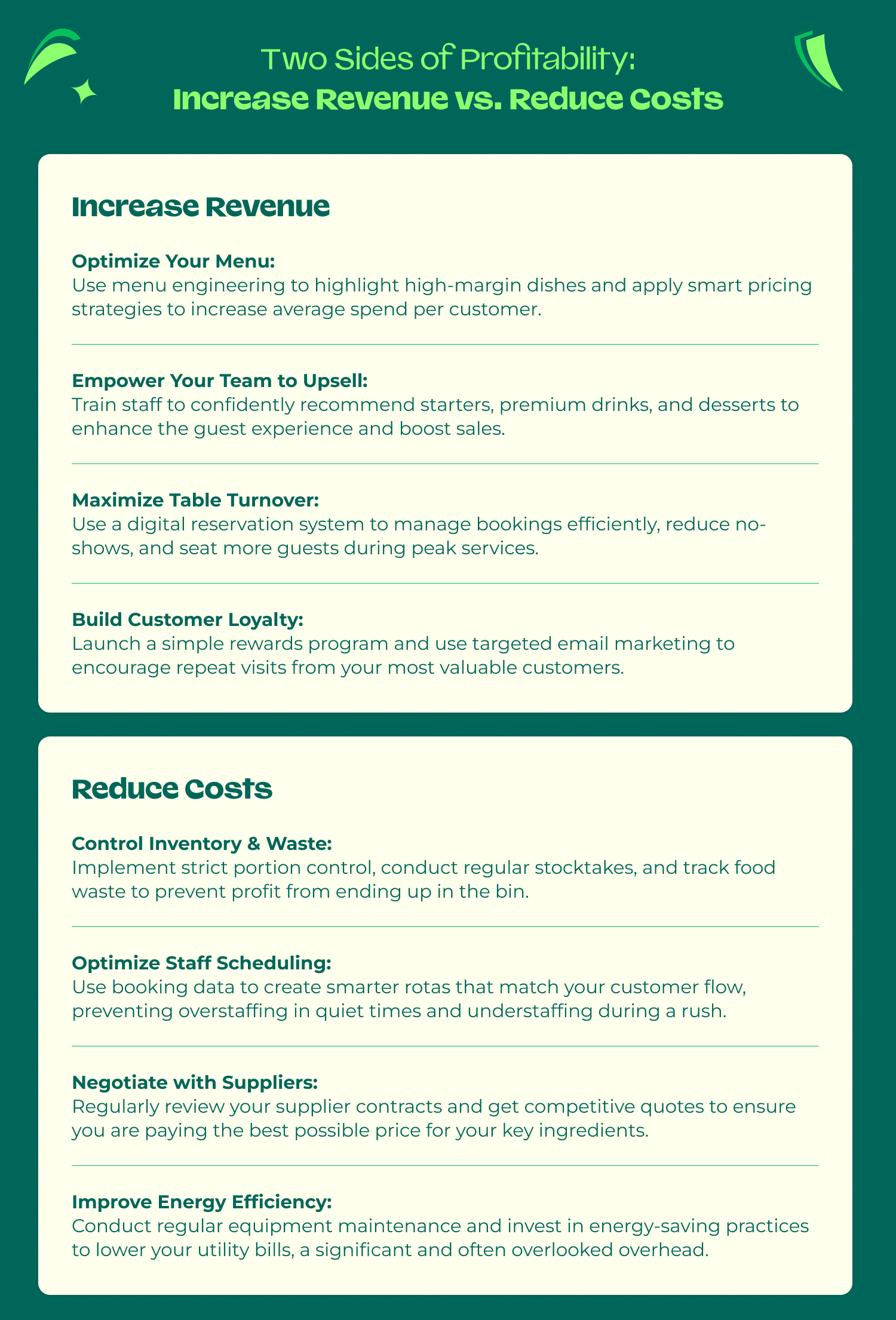
There are two fundamental ways to improve restaurant profit margin: grow your revenue or reduce your costs. The most successful restaurants do both simultaneously.
Increase Revenue
- Optimise Menu Pricing and Engineering: Use menu design to highlight your most profitable items. Analyse your sales data to identify bestsellers and remove low-margin, unpopular dishes.
- Train Staff to Upsell and Enhance Service: A well-trained server can increase average check size by recommending starters, desserts, or premium drinks.
- Boost Table Turnover and Reservations with Digital Tools: Use a reservation system to manage your floor plan efficiently, reducing wait times and seating more guests per service.
- Use Loyalty Programmes and Targeted Marketing: Encourage repeat business with a simple loyalty scheme and use email marketing to send targeted offers to past customers.
Reduce Costs
- Control Inventory and Minimise Waste: Implement strict portion control, conduct regular stocktakes, and track food waste to identify areas for savings.
- Schedule Staff Efficiently: Use your booking data to create smarter staff rotas, ensuring you are not overstaffed during quiet periods or understaffed during a rush.
- Review Supplier Contracts and Negotiate Better Deals: Don't let your supplier costs creep up. Regularly get competitive quotes to ensure you are paying the best price for your ingredients.
- Improve Energy Efficiency and Equipment Maintenance: Rising energy bills are a major concern. Invest in energy-efficient equipment and conduct regular maintenance to prevent costly breakdowns.
Profit Margin Examples by Restaurant Type
Full-Service Restaurant
A full-service restaurant in a city centre has high overheads (rent, staff). To improve its 4% net margin, it focuses heavily on increasing revenue through staff upselling of high-margin items like wine and cocktails, and by offering premium tasting menus.
Quick-Service Restaurant (QSR)
A QSR's profit margin relies on volume and efficiency. To protect its 8% net margin, it focuses on cost control by negotiating bulk discounts from suppliers and using technology to create highly efficient staff schedules that match customer footfall patterns.
Café or Food Truck
With lower fixed costs, a food truck can achieve a higher net margin of around 12%. It focuses on controlling food costs by having a small, specialised menu and leverages its mobility to operate in high-demand locations during peak times, like festivals or office parks.
Common Mistakes That Reduce Profitability
Setting Prices Without Considering Full Costs
A common error is to base menu prices only on food cost (COGS). This ignores the significant impact of labour and overheads. For example, a complex dish that requires a lot of chef preparation time must have a higher price to cover that labour cost, even if the ingredients are cheap.
Ignoring Food Cost Tracking or Waste
Failing to conduct regular stocktakes or track food waste is like throwing money in the bin. Without this data, a restaurant might be unaware that its portion sizes are too large or that a particular ingredient is consistently spoiling, both of which directly eat into profits.
Cutting Labour Too Deeply and Hurting Service Quality
In an attempt to reduce costs, some operators cut staff hours too aggressively. While this lowers the labour cost percentage in the short term, it often leads to poor service, negative reviews, and a long-term decline in customers, ultimately hurting the net profit margin far more.
Empty tables and ever-increasing costs?

FAQs
What Is a Good Profit Margin for a Restaurant?
A good net profit margin for a typical full-service restaurant in the UK is between 3% and 5%. However, this can be higher for quick-service models (6-9%) or lower for fine dining establishments with very high costs.
How Do I Calculate My Restaurant’s Profit Margin?
To calculate your net profit margin, subtract your total expenses from your total revenue for a specific period, then divide that number by your total revenue and multiply by 100 to get the percentage.
Why Are Restaurant Profit Margins Typically Low?
Restaurant profit margins are low due to the "Big Three" high costs: Cost of Goods Sold (food and drink), labour (wages and salaries), and overhead (rent, utilities). These expenses consume a very large portion of every pound earned.
How Can I Improve My Net Profit Margin Quickly?
For quick wins, focus on areas with immediate impact. Review your menu prices for underpriced items, run a staff upselling competition for a week, or conduct a waste audit in your kitchen to identify and eliminate obvious sources of waste.
What Is the Difference Between Profit and Cash Flow in Restaurants?
Profit is the money left over after all your expenses have been paid for a given period. Cash flow is the actual movement of money in and out of your bank account. A restaurant can be profitable on paper but still have cash flow problems if, for example, it has large, upfront payments to suppliers.
What Tools Help Track Restaurant Margins Automatically?
Modern POS systems and accounting software are the best tools. They can integrate to automatically track your sales, food costs, and labour expenses, providing you with real-time dashboards to monitor your key financial ratios and profit margins.